Monday, March 21, 2011

Salzburg, Austria - May 31st, 2010

The camp site entrance, not particularly welcoming
 but then it was early in the seas
Our well appointed mud patch
There is a lot of juice (we believe) in Salzburg and it was our intention to do a walkabout there on our way south. We overnighted in an ill-prepared campsite and set off to see the city first thing in the morning. Unfortunately, what with extensive roadworks and unbelievable traffic density, after an hour of stop-go motion with never a parking space to be seen we cried Uncle andleft.
 Salzburg - Salt Castle - is the fourth-largest city in Austria and has a population of about 145,000. The Altstadt - old town - is regarded as one of the best preserved examples north of the Alps and made the UNESCO World Heritage list in 1997. The capital city of the State of Salzburg, it is host to three universities resulting in a large student population adding an upbeat energy to the area.
We declined the opportunity to take on fresh water
since the potable water hose was artistically
draped around the black waste bowl
The name "Salt Castle" derives from barges carrying salt on the Salzach River which, in the 8th century, were subject to a toll customary for many communities and cities on European rivers.
Salzburg was the birthplace of 18th-century composer Wolfgang Amadeus Mozart and, in the mid-20th century, was the setting for parts of the film The Sound of Music. Traces of human settlements in the area dating to the Neolithic Age have been discovered while the first settlements at Salzburg were probably Celtic in the 5th century BCE.

Nuremberg, Bavaria, Germany - May 30, 2010


Nuremberg was a favorite stomping ground - literally - for Adolph Hitler during his "excite the masses" period of 1927 to 1938 or so. A week long rally held here each September would rouse a rabble of as many as 500,000 to attend a magnificantly choreographed display of histrionics, goose-stepping march-bys, banner waving and even mock battles. After the war ended, of course, Nuremberg became the venue for the eponymous trials. A dark chapter indeed.
Today, this historic Bavarian city on the Pegnitz river and the Rhine–Main–Danube Canal has a population right at 500,000. Nuremberg is believed to have been founded around the turn of the 11th century and is sometimes acknowledged to have been the 'unofficial capital' of the Holy Roman Empire.
In the nineteenth century Nuremberg became the "industrial heart" of Bavaria with companies such as Siemens and MAN establishing strong bases there. The Nuremberg International Toy Fair is the largest of its kind in the world. Perhaps most famously, the main part of Nicolaus Copernicus's work was published in Nuremberg in 1543.
During WWII, Nuremberg was the headquarters of Military District) XIII and an important site for the production of airplanes, submarines, and tank engines. 
The city was severely damaged by Allied bombing from 1943 to 45 and on January 2, 1945, the medieval city center was bombed by the Royal Air Force and the U.S. Army Air Forces. About ninety percent of it was destroyed in less than an hour, Happily, the city was rebuilt after the war and was partly restored to its pre-war appearance. Lots more images here.

Thursday, March 10, 2011

Würzburg, Germany - May 28th 2010

On March 16, 1945, Würzburg was severely damaged in a seventeen minute attack by 225 British Lancaster bombers. Most of the city's churches, cathedrals, and other monuments were casualties and the city center was totally destroyed in a firestorm that claimed 5,000 lives. 
Over the next 20 years, the buildings of historical importance were painstakingly and accurately replicated. Würzburg was destroyed more completely than was Dresden in a firebombing the previous month. 
From the end of the war until 2008, the U.S. Army's 3rd Infantry Division along with other U.S. military units were stationed near the town and was hugely beneficial to the local economy. Würzburg is about 70 miles from both Frankfurt am Main and Nuremberg and has a current population in the region of 130,000.
The Celts had a fort on the hill where Fortress Marienberg stands today as early as 1000 BCE and the setlement was Christianized in 686 CE. The first church on the site of the present Würzburg Cathedral was built in 788, and was consecrated by Charlemagne.
Würzburg's Old Main Bridge - Alte Mainbrücke - built 1473–1543 to replace the destroyed Romanesque bridge from 1133, was later decorated with well-known statues of saints and famous persons. 
The University of Würzburg contains Wilhelm Röntgen's original laboratory, where he discovered X-rays in 1895 and also awarded Alexander Graham Bell an honorary Ph.D for his pioneering scientific work. Our day in Wurzburg was comfortably relaxed and we were pleasantly surpised by the homogenous nature of the old town. Lots more pictures here.

Tuesday, March 08, 2011

Trapped in Numansdorp, NL - May 16 to May 26 2010

When we are not using our little Pilote RV in Europe, it is stored in the tiny town of Numansdorp in the South Holland region of the Netherlands. The storage company looks after the annual medical for the vehicle and generally does a good job. 
This year they recommended replacing the main drive belt in the engine since it was beyond its "best by" date and a failure of this item is very, very bad. So the belt was changed in time for our arrival - an expensive task, but, we thought, good insurance.
Well, as you may have heard, the road to hell is paved with good intentions. Thus it was that, on a 30 degree Saturday morning on an Autobahn near Erfurt, in Germany, we experienced the aforementioned very, very bad. A single lurch, one expensive graunch from under the hood and we were immobilized on a rain soaked freeway.
To cut a long story short, 30 hours and $2,200 later we had been hauled 400 miles on a wrecker and delivered back to Numansdorp! Hooray for a 10 day static hiatus in rain swept Holland.
Numansdorp has a population of 9910 residents and is a typical Fisher-Price like Dutch toy-town with stunningly neat, but infuriatingly small everything - roads, roundabouts, stores, houses - everything. So the storage yard became our base while insurance adjusters, parts suppliers, a National Holiday, the mechanic and fate all worked their tedious magic. 
Our major concern was getting out in time to reach Venice, Italy, by June 4th when our visitors from America were scheduled to arrive. One way and another, we busied ourselves with bike rides, shopping, reading and general catching up while a new cylinder head  and other vital organs were procured and installed. Check here for fun ways to pass time in Holland.

Monday, March 07, 2011

Mühlhausen, Germany - May 14, 2010

Reven's Tower and City Gate
Mühlhausen - officially Mühlhausen/Thüringen - lies along the river Unstrut and is home to about 37,000 souls. Its first known recorded mention was in 967 and, although King Henry the Fowler bestowed some priviliges upon the area, the 13th through the 15th centuries were the town's real heyday. Later, for less than a year in from 1707-1708, Johann Sebastian Bach tinkled the ivories on the organ in the Church of Saint Blaise.
One of these built the Brooklyn Bridge -
read on to find out more
The town was pretty much wrecked between 1618 and 1648 during the Thirty Years' War and was further trashed during the Seven Years' War from 1756 to 1763. These disasters, along with endles political infighting reduced the place to insignificance. Like much of the area, it fell to Prussian authority in 1802, was conquered by the Kingdom of Westphalia in 1807 before being snatched back by Prussia again in 1815. From 1944 to March 1945, a slave labor camp for women was operated outside of town until the inmates were deported to Bergen Belsen in April 1945.
A relatively small old town with few "big rides" (or any rides at all) we nevertheless had a pleasamt trudge around in cool, sunless weather. See here for some views.

Göttingen, Germany - May 13, 2010

The Georg-August-Universität was founded in Göttingen in 1737 and currently has 24,000 students on campus - almost one in five of the total city population. Many students live in and around the old city and imbue it with a youthful energy. The city itself came into being in the second half of the 12th century.
Following the upheaval of the Reformation there was a dearth of Catholic churches in the entire region and it wasn't until 1787 that the first new one, Saint Michael's, was built. Saint Paul's was the second post-Reformation Catholic church and that didn't appear until 1929.
There has been an ongoing secular trend throughout Germany since WWII, more so in Eastern Germany, and a growing number of people choose not to be baptised or otherwise leave the church. This trend has slowed somewhat in the new millenium and the larger churches are more or less stable.
About two weeks after we visited Göttingen, an 1,100 lb WWII bomb exploded on the construction site of a new stadium. This was the second bomb found on the site - the first was disposed of safely - and three people were killed in the incident. 
More pictures from our walkabout are here.

Thursday, February 24, 2011

Goslar, Germany - May 12, 2010

During the cold war, Goslar was part of Eastern Germany and host to a huge army camp. After reunification the camp was dismantled and the city suffered serious economic disruption as a result. Even today, unemployment is high and the city, which has invested enormously in the development of tourism to rebuild revenues, was fortunate to make the World Heritage listing in 1992.
Just south of town is Rammelsberg, a 2000 foot high mountain, housing a mine that was in continuous operation for more than 1,000 years before its closure in 1988. During its life, 30 millions tons of ore containing Copper, Gold, Lead, Silver and Zinc were removed.
Goslar has been home to Neolithic man, the Saxons, the Holy Roman German empire, Reformation, Enlightenment, German Nationalism, Emancipation, Militarism, German Imperialism, Democratization, the Nazis, Soviet dictatorship and, as of 1990, reunification with the west.
The Imperial Palace was built in the 11th century and served as a summer residence for German emperors. The cathedral was built at the same time, but only the porch survives, the rest having being torn down in 1820.
The city is a regional shopping center with department stores, supermarkets and boutiques as well as a weekly farmer's market. Goslar is also the ancestral home of the Siemens family, founders of the eponymous international conglomerate. For additional snapshots, click here.

Monday, February 21, 2011

Quedlinburg, Germany - May 11, 2010

Quedlinburg was one of those "might as well since we are here" opportunities that turned out to be a true gem. In the Harz district of Saxony-Anhalt, Germany, Quedlinburg has been a UNESCO World Heritage site since 1994. 
Mention of the town can be found in the early 9th century and later the town became the province of King Henry the Fowler.  Henry died in 936 and his widow, Saint Mathilda, founded a convent on the castle hill, where daughters of the higher nobility were educated. 
The abbey was secularized in 1802 during the German Mediatization when Quedlinburg was absorbed into the Kingdom of Prussia. Five years later it was lost to the Napoleonic Kingdom of Westphalia before being won back by the new Prussian Province of Saxony in 1815.
During the Nazi regime, for unknown reasons, King Henry took on cult status and Heinrich Himmler imagined himself to be the reincarnation of the "most German of all German" rulers. Plans were made to turn the collegiate church and castle into a shrine for Nazi Germany and the Party even set out to create a new religion. 
The cathedral was closed from 1938 until 1945 when Liberation saw the reinstatement of a Protestant bishop and the removal of the Nazi style eagle from the tower. From 1949 to 1990 Quedlinburg became part of Communist East Germany until, on German reunification, it became part of the state of Saxony-Anhalt. 
Today, in the innermost parts of the town, there is a wide selection of half-timbered buildings from at least five different centuries. For more images of this exquisite city, see here.

Wittenberg, Germany - May 10, 2010

Wittenberg, officially known as Lutherstadt Wittenberg, is a small city of 50,000 people on the river Elbe in north eastern Germany. In 1502 the University of Wittenberg was founded and became the center of activity for Martin Luther who, in 1508 at the age of 25, became a Professor of Theology there.
Had it not been for Martin Luther, Wittenberg would probably have remained just another rural backwater German city. Luther however, become increasingly aggrieved by the Catholic church practice of selling indulgences - that is allowing wealthy folk to buy forgiveness for their misdeeds by giving money to church Bishops. 
Folklore has it that Luther nailed 95 theses on this topic to the doors of the All Saints' Castle Church in 1517. This part of the story, like other elements of Wittenberg folklore, actually appears to be romantic fantasy but there is no doubt that Luther's activities there sowed the seeds for the Protestant Reformation leading to a massive religious upheaval and European-wide warfare.
The Castle Church was damaged by fire in 1760, during the Seven Years War with France,  and the doors (along with the mythical pamphlets) were destroyed. Even though the church was patched up, it wasn't before 1858 - almost 100 years later - that new bronze doors were installed and these, indeed, were inscribed with the text of the theses in Latin. Fanciful thinking apparently had won out over reality and morphed into "fact". The tomb of Martin Luther is inside the Church. 
A couple of other Wittenberg myths are connected to WWII. Unlike many historic German cities in the region, Wittenberg was spared major destruction although there was some fighting in the streets. The statue of Martin Luther that stands in the main square has some pock marks on it proudly pointed to by locals as WWII bullet holes. Nice try, but the statue was actually in storage some miles out of town for the duration of the war.
The other piece of romanticism holds that the Allies had agreed not to bomb Wittenberg and that was the reason the city escaped serious damage. Reality was that the Arado Flugzeugwerke (Arado Aircraft Factory), a Luftwaffe production facility, was on the outskirts of town and the allies did indeed avoid action  for a long time, but for a unilateral and humane reason. The factory was staffed by forced labor including Jews, Russians, Poles, political prisoners and even a few Americans. Near the close of the war, American and British planes did bomb the factory tragically killing about one thousand prisoner workers. 
When the war ended in 1945, Wittenberg was occupied by Soviet forces and became part of East Germany in 1949. It has since of course, been reunited with western Germany since 1990. Picture show here.

Friday, February 11, 2011

Berlin, Germany - May 8, 2010

Holocaust Memorial
Berlin, once again the capital city of Germany, is also one of the sixteen states of the reunified country. With a population of 3.4 million, it is Germany's largest city and is located in northeastern Germany. Approximately one third of the city's area is composed of forests, parks, gardens, rivers and lakes. 
First documented in the 13th century, Berlin initially became the capital of the German Empire shortly after its formation in 1871 and the city expanded rapidly in the following years. 
Neptune's Fountain
The city's character has been shaped, or perhaps confused, by the turbulent roles it has endured in Germany's history, especially during of the 20th century. Each of the national governments based in the city - ​the original 1871 German Empire, the post WWI Weimar Republic, Nazi Germany of 1933, East Germany in 1950, and now the 1991 reunified Germany​ - embarked on grandiose construction programs, each with little regard to what came before. 
Exacerbating the devastation of WWII bombings, many of the remaining historic buildings were torn down in the 1950s and 1960s, by both the Western and Eastern governments, to make way for municipal architectural programs competing to build two distinct cities. The result is an unsettling hotch-potch of styles and neighborhoods. The site of Checkpoint Charlie, one of the renowned crossing points of the cold war Berlin Wall, is still preserved and also has a museum.
A Conference Bike
All four allies in fact shared responsibility for Berlin after WWII but, in 1948 when the West introduced the west German Mark as the currency for Berlin, the Soviet Union imposed a blockade on the landlocked American, British and French sectors. The blockade was eventually beaten by the Berlin Airlift, which flew in food and other supplies to the city from 24 June 1948 to 11 May 1949.
On October 3, 1990, the two parts of Germany were reunified as the Federal Republic of Germany, and Berlin became the German capital for the fifth time in accordance with the unification treaty. In June 1991 the German Parliament, the Bundestag, voted to move the German capital back from Bonn to Berlin. For a picture show of this long suffering metropolis, click here.

Wednesday, February 09, 2011

Checkpoint Alpha, Helmsedt, Germany - May 6, 2010

Bleak day at Checkpoint Alpha

 Helmstedt is at the eastern edge of Lower Saxony, the border of which marked the transition from the British chunk of Germany to the Soviet portion. 
Berlin, a further 105 miles to the east, mirrored the arbitrary division of the entire country of Germany into four pieces and was itself divided into American, British, French and Soviet sectors. 
Fairly quickly after WWII ended and the Cold War got underway, three Checkpoints sprang to prominence: Checkpoint Alpha, Checkpoint Bravo and the most renowned of all, Checkpoint Charlie. Checkpoint Alpha controlled access to the 105 mile east German road connecting Helmstedt to Berlin - more specifically to Checkpoint Bravo on the southwest corner of the American sector. 
Die Wölbung der Hände
Movement within the American, British and French sectors was unbridled but to enter the Soviet sector (and thereby east Germany) it was necessary to pass through Checkpoint Charlie. 
It was Checkpoint Alpha that the Soviets closed to initiate the Berlin Blockade from June 1948 until May 1949. There is little left now of this once expansive checkpoint, its dark passing is marked by a homely memorial called Die Wölbung der Hände (The Curvature of the Hands) as the reunited pieces of Germany struggle to put their lives back together.

Celle, Germany - May 5th, 2010

Moving next to Lower Saxony, we visited Celle, a market town of about 70,000 on the River Aller. Celle comprises 17 municipalities, some of which were independent vilages in earlier times.
The city was relatively unscathed by WWII with only one serious air raid that occurred in April1945, destroying less than 70 houses or about 2% of the structures.
Today, tourism is a large slice of Celle’s economy, with jazz, wine and other festivals in the summer months along with the year round attraction of the hundreds of old town buildings dating back to the 16th century. A romantic looking castle, Schloss Celle, built in 1530 along with the Stadtkirche from 1308 serve as anchor attractions for tourists. 
Of passing historical interest is the Army airfield 3 miles southwest of the town. This operated as RAF Celle after the Second World War and was the launch point for the 1948/49 supply flights of the Berlin Airlift
For more pictures of this attractive and lively city, click here.

Wednesday, January 12, 2011

Osnabrück, Germany - May 3, 2010

Our annual assault on Europe in 2010 was more structured than usual since we were scheduled to meet one of our granddaughters and a friend of hers en route, at about the halfway mark. As events transpired, we were driven way off track but did recover in time to collect the youngsters in Italy. More on that in future posts.
We set off from our usual launch site in the Netherlands and aimed for Osnabrück, a city in Lower Saxony, Germany, highlighted on the map top right. The population of Osnabrück is around 160,000 making it the third largest city in the region.
Developed originally in 780 CE as a marketplace when the area was controlled by Charlemagne, King of the Franks, in 889 Osnabrück was given merchant and coinage privileges by King Arnulf of Carinthia.
Lots more history over the next millennium although it wasn't until 1561 that anything really memorable happened. In that year Osnabrück killed its first witch the result of which must have been beneficial, for over the next 80 years they killed a further 275 witches and 2 wizards.
Today the city has a run down air not helped by the overcast and gloomy conditions that prevailed throughout our visit. For more views of this ancient city, click here,

Sunday, January 09, 2011

San Juan, Puerto Rico - November 7th 2009

Part of the 16th century defensive walls
Municipio de la Ciudad Capital San Juan Bautista (San Juan), is the capital city of Puerto Rico ("rich port" in English), an unincorporated territory of the United States which, with 650,000 population, ranks as the 42nd largest US city. Founded by Spanish colonists in 1521, San Juan is the second oldest European-established city in the Americas, after Santo Domingo.
Christopher Columbus, on his second trip in 1493, named the island San Juan Bautista, in honor of Saint John the Baptist. Curiously, the ambiguous use of San Juan Bautista and Puerto Rico for both the city and the island led to a reversal in use, such that by 1746, the name for the city (Puerto Rico) had become that of the entire island, while the name for the Island (San Juan Bautista) had become the name for the city.
Spain ceded the island to the United States in 1898, an outcome of the Spanish-American war, and its citizens were afforded US citizenship in 1917. While said citizenship excluded the privilige of voting in presidential elections, it did qualify all islanders to participate in the draft during WWI and WWII. The island, the smallest island by land area of the Greater Antilles, endures a high humidity, year round average temperature close to 80 F with occasional highs of 90. In severe winter conditions in 1957, a record low of 60 F was recorded! Click here for Slideshow.

Friday, January 07, 2011

Charlotte Amalie, AVI - November 6, 2009

On his second visit to America in 1493, Christopher Columbus bestowed the Virgin moniker on an archipelago of the Lesser Antilles in the Caribbean Sea in honor of Saint Ursula and her virgin followers. The present US Virgin Islands was part of this group and comprises Saint Croix, Saint John, Water Island and Saint Thomas along with some smaller islets. With an area of 133 square miles - about twice the size of Washington DC - the American Virgin Islands are home to a little over 100,000 people, mainly of African descent from the days of sugar cane slavery. Over the centuries since 1493, the islands have been held by sundry European powers, including Spain, the United Kingdom, the Netherlands, France, and Denmark-Norway.
The Danish, who held the islands in the mid 19th century, abolished slavery in 1848 rendering the entire possession a money pit that required huge subsidization for the next 60 years. Despite several attempts to sell the islands, it wasn't until WWI and the American fear of the German submarine bases being established there, that a deal was finally struck. In 1917 the USA became the new owners at a cost of $25 million - about half a billion in today's money. All the inhabitants were granted US citizenship in 1927. Today, tourism is the primary economic activity.
With a population of 19,000, the capital city of the group is Charlotte Amalie on St Thomas, named after Charlotte Amalie of Hesse-Kassel (1650–1714), queen consort to King Christian V of Denmark. The city is generally very warm and humid with average temperatures at a near constant - highs about 88°F and lows about 75°F. Click here for Slide-show.

Thursday, January 06, 2011

Funchal, Madeira


Madiera is the main island of a small Portuguese archipelago about 500 miles west of the African Atlantic coast. Funchal, on the south side of the island, has been the capital since the island was settled by Portuguese explores more than 600 years ago. Although we had visited here on a previous cruise we decided to go ashore and stroll around anyway. The weather was warm and muggy and, from the dock that our cheesy cruise line had secured (the cheap seats, so to speak), the walk to town seemed never ending. Sapped of energy, we managed a rotish walkabout and returned to the ship fairly shortly.
The island is roughly 28 by 10 miles and towers almost 4,000 feet above the ocean. In February 2010, a few months after our visit, the area was racked by torrential rain storms causing flash flooding, sustained run-off and about 50 deaths. Hopefully, this may provide an opportunity to clean up some of the poorer parts of the city. More pictures here.

Wednesday, November 10, 2010

Málaga, Spain


With its population of almost 600,000 Málaga is the sixth largest city in Spain and the southernmost large city in Europe. It lies on the northern Mediterranean "Coast of the Sun" - Costa del Sol - about 60 miles east of the Strait of Gibraltar and 80 miles north of Africa. The city enjoys a subtropical climate and boasts the warmest winters in Europe, with average daytime temperatures above 63 °F from December to February.
Málaga is one of the oldest cities in the world with a 2,700 year history since it was founded by the Phoenicians as Malaka about 770 BCE. After the Phoenicians the city was controlled by the Roman Republic, then the Roman Empire followed by the Arabs until 1487 when it became, and has remained, a Spanish possession. Key commercial activities are tourism, construction and technology services but efforts are in progress to diversify.
The painter and sculptor Pablo Picasso was born in Málaga. Get a lightning tour here.

Monday, October 18, 2010

A really nice boat, but...

The MSC line has a romantic name for each of their ships, MSC Magnifica, MSC Splendida, MSC Fantasia, MSC Poesia and so on. Our incarceration was on the Poesia - Italian for Poetry - and each deck was named after a famous Italian poet. Famous Italian poet! - there's an oxymoron if ever there was one.

The Poesia was commissioned in May, 2008, and, at eighteen months old, was in first class condition. No complaints in that department. Unfortunately, that is the entire list of positive attributes I can come up with. The rest of the "package" was a recurring horror.
American based cruise lines have long since moved away from fixed seating dining - a regimen wherein there is normally two dinner times, 6:30 and 9:00pm for example, and the hapless inmates choose one or the other for the duration of their sentence. They are then assigned to a table seating from two to as many as 10 people - the same 10 people for dinner every night of the trip! Woe was us.
Assigned to a table for eight, we were cell mates with a pleasant couple from Antibes, in France, he German, she French along with four caricatures of everything bad about herd traveling. Two obnoxious sisters from Texas vulgarly flaunting their inheritance from Daddy and a veterinarian from the backwoods of Canada with ill fitting teeth complete with matching wife.

For my taste, give me meat and potatoes and 15 minutes, and I'm ready to move on. Not so for these excruciating waterbourne soirees.
Nothing was ever quite right for the Texan mamas. Hot tea was required with every course and its delivery never failed to elicit an imperious "Where is the honey?". The wine was corked, cloudy, too hot, too cold, veggies not cooked or overcooked - it was always something.
The hayseed animal molester was equally aggravating. Having left the epicenter of culture back in Calgary or wherever, these hicks were determined to get value for their money. They ordered every course - all six of them - at every meal but only after prolonged interrogation of the poor waiter over each dish, as they struggled to understand what it actually was. Whenever they had any doubt about what might turn up they simply ordered a second, different dish as a standby.

Now the restaurants open promptly at 6:30pm and purport to shutter their doors at 6:45pm to discourage latecomers. Our schedule thus was boxed in: beginning at 6:45, we endured a 45 minute pantomime while our companions haggled and argued over their selections. Then, waiting
patiently(?), while the Cheese and Fruit course was chomped to oblivion by the horse-dentured vetinerarian. Next up, with unabashed lethargy, he and his spouse would pick their way round the salad course which, once completed, was followed by soup which they slurped and dribbled through with the finesse of large Labrador dogs. Hooray - if all went smoothly, by 8:15 the main course arrived and five minutes later we had eaten and left. Can't think how we denied ourselves the experience of dessert, cheese plate, coffee and after dinner drinks, but we did.
Two nights of this were enough, and we determined to dine at the buffet instead. Error! Unlike every other cruise ship wherein the buffett is a 24 hour-a-day affair, seamlessly morphing from breakfast, to lunch, to afternoon tea to dinner to early morning pastries and back to breakfast, all the time maintaining a fresh fruit selection, desserts, beverages, ice cream, pies, custards etc., the MSC buffet closes completely at 4pm and then reopens one section from 8 to 11pm to serve - Pizza? No contest. Faced with more time at the trough with the sassy sisters and the dozy doc, the pizza won hands down. But wait! Obviously the Italians have never been to Papa John's or Pizza Hut to sample real pizza - here they were making genuine Italian pizza (as if there is such a thing ;o) ) that would be too far severe even for Weight Watchers. Oh well.

Breakfast was another daily debacle, no matter where one hid on the ship. At 9:30am sharp an abrasively plangent female read the ship's daily newsletter over the public address system at a volume ensuring that it could not be missed. Although this recitation took only 4 or 5 minutes to complete, that was just the Italian version.
The entire missive was then repeated five more times in German, French, Dutch, Spanish and English. Totaly exhausting.
As for the food, we skirmished with the chaos of the formal restaurants two or three times for breakfast and lunch - couldn't get cold milk for cereal, did get cold coffee; couldn't get crispy bacon, did get crispy egg - you get the idea. So as self-exiled dining room outcasts we were doomed to the buffet. Reminiscent of POWs in WWII movies, we quickly discovered the secret of restarting the beverage machine after it had been shut down by the guards, learned exactly when to strike at the pastry counter to snag the edible ones and even found the back door to the gelato machine. Eventually we even managed to bribe the jackbooted Maitre d' of the second main restaurant and were awarded a private table for two for the rest of the trip. Not too shabby.

When the ship finally entered US waters, the FDA swarmed on board, - well, maybe not swarmed, more sort of lumbered - inspected the facilities, promptly shut down all the kitchens and revoked landing permission in Charlotte Amilie. Pretty much everything came to a halt at this point for 12 hours or so while every crew member that wasn't dead or mortally moribund, scrubbed, polished, swept and sterilized every nook and cranny on the ship. Beyond smelling like a hospital for the next day or so, not much else seemed different but the redoubtable G-Men were satisfied.
Cleaning up the ship unfortunately, did nothing for the shameful condition of the two Unincorporated Organized Territories - possessions of the USA - that we were to visit next. These shabby communities presented a shameful introduction to America for the 2,000 Europeans on board.

Saturday, October 16, 2010

Part II - A Brush with Disaster in Tunisia


Our introduction to Africa was not too propitious. Overall though, the day blended quite easily into the rest of the trip and thus passed with little notice. Having had our cab driver disappear for a nooner or whatever in the middle of downtown Tunis, when he finally reappeared his stunt driving efforts to get back on schedule ended with his cab totaled and us marooned in the middle of a freeway. When, finally we were rescued, the poor guy was
slumped against his wreck repeatedly mumbling "De firsta accidenta in thirty years".
By this time we were really late. The replacement cab and driver eventually arrived and he did his level best to complete the itinerary but, when we arrived back at the dock entrance, we discovered he was not authorized to enter so we had to leg it back to the ship. About halfway there the local MSC Cruise Line Agent screeched to a halt beside us, motioned for us to get in and fairly flew to the quay. Here, the last gangway was being hauled on board and the ship was about to leave. Abandoned in North Africa was a fate we were grateful to miss.

The Tunisian Republic is about the size of Washington state with a population of about 10.3 million - 1-1/2 times that of Washington state - and is both the smallest nation along the Atlas Mountain range and the northernmost country in Africa.
It is an Arab country bordered by Algeria to the west, Libya to the southeast, and the Mediterranean Sea to the north and east. With its name is derived from the capital Tunis, located in the north-east, the south of the country is part of the Sahara desert while the remainder is mainly fertile soil. It boasts nearly 800 miles of coastline.
This combination of arable land close to the coastline has played a prominent role throughout recorded history. First was the famous Phoenician city of Carthage, then came the Africa Province known as the "bread basket" of the Roman Empire. Later, during the 5th century CE, the area was occupied first by Vandals, then Byzantines in the 6th century and Arabs in the 8th century before being subjugated by the

Ottomans at which point it became the "Regency of Tunis". The Ottomans were driven out as the European scrambled to confirm their Empires in the 19th century, becoming a French protectorate in 1881.
Finally, after obtaining independence in 1956, the country took the name of the "Kingdom of Tunisia" until the end of the reign of Lamine Bey and the Husainid Dynasty. With the proclamation of the Tunisian Republic on July 25, 1957, the nationalist leader Habib Bourguiba became its first president and the modernization of the country began.

Today Tunisia is an export-oriented country, in the process of liberalizing its economy under an authoritarian regime controlled by Zine El Abidine Ben Ali and masquerading as a procedural democracy. Ben Ali has governed as President since 1987 and has systematically diminished freedom of press and political pluralism while maintaining the charade of democratic elections.
In the September 2009 election his share of the vote fell to its lowest ever at, 89.4%, mainly because he allowed an opposition party on the ballot. If the opposition candidate had not been jailed during the run up to the election or had been allowed to give speeches or organize gatherings, it's possible he could have done even better than his 5% share, but that's just speculation! Pictures of the tour are here.

Tuesday, October 12, 2010

The Cruise from Hell - Part I

MSC - Mediterranean Shipping Company - is an Italian cruise line which operates about half-a-dozen vessels. Any country that has used up more than 60 governments since 1948 suggests that it might not be a paragon of organizational stability and, in hindsight, an Italian cruise ship was perhaps not our best choice. Even allowing for a bout of food poisoning following the first evening's dinner followed, of course, by 24 hours of Technicolor yawns, we have never been on a cruise before during which we actually lost weight! Yes, we both lost 3-1/2lbs - on a cruise ship. More of that anon.
The ship sailed on schedule, navigated its way through the Canale Della Giudecca past the island of Venice, across the lagoon and out into the Adriatic Sea. At sunrise next morning we were docked in the Adriatic port of Bari, on the eastern coast of southern Italy.
Bari has the unfortunate distinction of being the only city to suffer the effects of chemical warfare during WWII, unintended though it was. The Allies, fearful that Hitler might resort to chemical attacks as he was pushed to the wall, had stockpiled mustard gas on Bari dock - a highly classified strategy at the time. Bari was a key supply point for the Allies and, in a December 1943 air attack by the Germans, the stockpile was unwittingly bombed. Fatality estimates due to the gas vary from less than 70 people to more than 2,000, a confusion generated since neither the rescuers nor the medical teams had any idea what they were dealing with. Ignorance of the presence of mustard gas resulted in numerous otherwise avoidable casualties all muddled in with the conventional carnage wrought by the air attack. Franklin D. Roosevelt, Winston Churchill and Dwight D. Eisenhower ordered the records destroyed and the incident remained a secret until 1959.
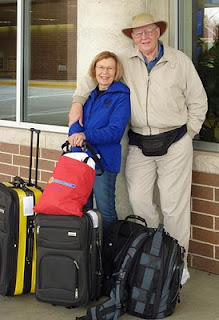
I did not visit the town, being too pre-occupied with puking and moaning and completely consumed with self-pity. Marian went ashore and took some snaps of the city.

Friday, October 08, 2010

A Mediterranean Quickie

I really need to do a better job in keeping this blog current. The previous post, made in April of this year, completed our 2009 Fall trip to England for our best ever pub crawl. Shamefully, this post is almost exactly one whole year after the event. However, with a few more paving stones on the road to Hell, here goes.
Suffering some serious boredom waiting for Thanksgiving to arrive, we cast about and found a nice little cruise that embarked in Venice, Italy and disgorged us, three weeks later, in Fort Lauderdale, Florida. We grabbed our bags and left.
A trio of tiresome flights and one day later we staggered out of Marco Polo Airport and took the bus to our hotel on the island of Venice. We had planned to take a night tour of Venice but it piddled down with rain all evening and we made do with a deplorably bad supper in a "genuine Italian family" restaurant next door to the hotel. We wondered if their family motto was "We may not be good, but we're not cheap".
Bright and early next morning we made a quick perambulation of the island trying to fill in gaps from an earlier visit. It was certainly interesting to see the city in the early morning and, although the weather was not too cooperative, the walk was refreshing. Snapshots here.