 |
| See Slideshow |
Thursday, August 30, 2018
Rochefort-en-Terre, Brittany, France

Tuesday, August 28, 2018
Saint Goustan, Auray, France
By the fall of 1776 the War of Independence between the newly minted United States of America and Great Britain was in danger of being lost to Britain as the USA ran out of money and resources. France, for centuries Britain's arch-rival, was seen by Congress as the only hope to turn the tide and Benjamin Franklin, a personal hero of mine, was selected to visit France with his nation's begging bowl.
Duly, in December 1776, Franklin arrived in Port Saint Goustain in Britanny, France, on his way to see the French King and his advisers. Saint Goustan, named after the patron saint of fishermen and sailors, is on the south coast of the Brest peninsular in northwest France, about 10 miles up the Auray river and 300 miles from Paris.
After much prevarication, Franklin eventually reached agreement with the French who joined the war effort and the rest eventually became history. This French largesse however, motivated by their desire to get one over on the Brits, almost bankrupted France and was certainly a contributing factor in Frances own revolution a dozen years later.
St Goustan, originally a fishing port, served as a boat building center and a commercial port until it was sidelined by the railroad in 1860. Today, this tiny commune is part of the much larger Auray community and exists mainly as a tourist attraction centered on the Franklin Quay and the Franklin Inn. See Slideshow.
 |
| See Slideshow |
After much prevarication, Franklin eventually reached agreement with the French who joined the war effort and the rest eventually became history. This French largesse however, motivated by their desire to get one over on the Brits, almost bankrupted France and was certainly a contributing factor in Frances own revolution a dozen years later.
St Goustan, originally a fishing port, served as a boat building center and a commercial port until it was sidelined by the railroad in 1860. Today, this tiny commune is part of the much larger Auray community and exists mainly as a tourist attraction centered on the Franklin Quay and the Franklin Inn. See Slideshow.
Friday, August 24, 2018
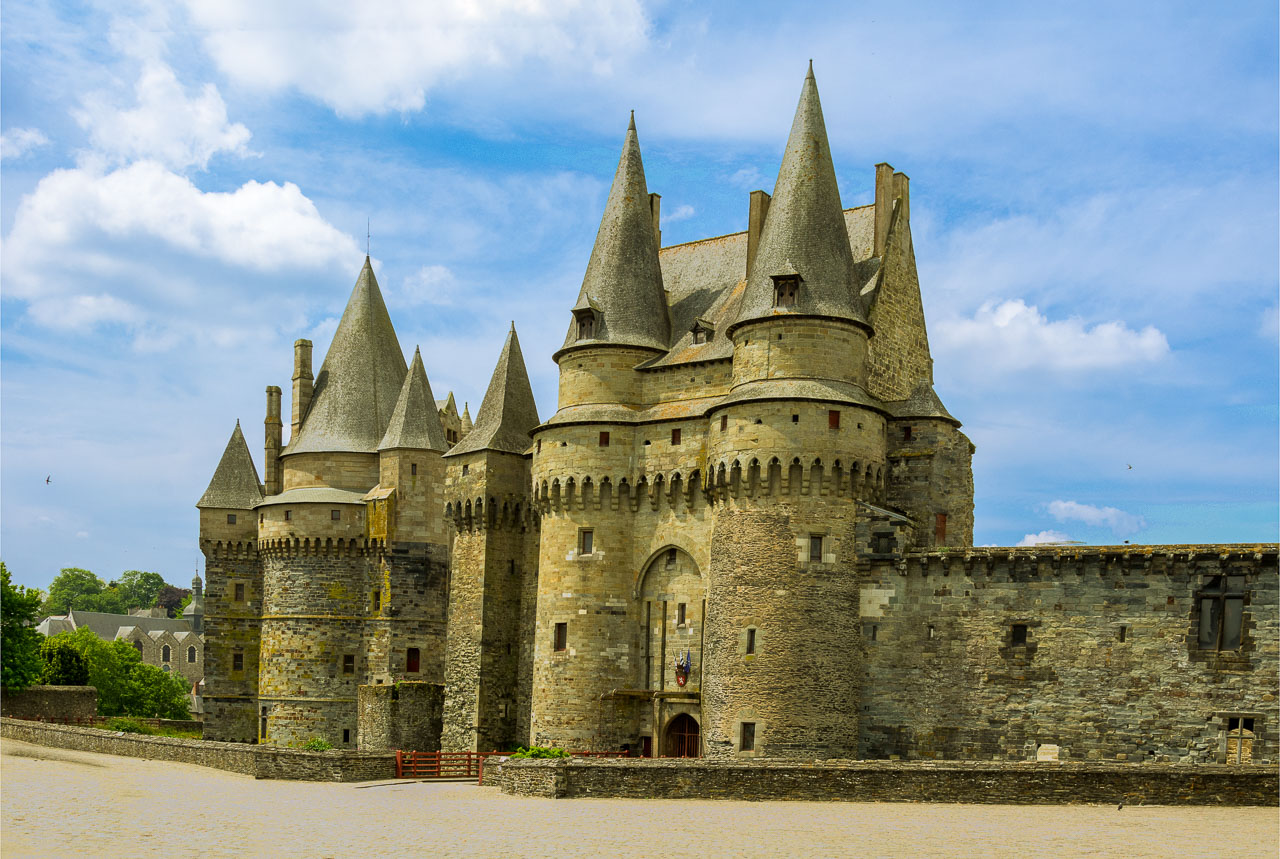
Vitre, Britanny, France 2018
 |
| See Slideshow |
Vitre has a population close to 18,000 and is pretty much on the border of Brittany with Lower Normandy. Designated by the Ministry of Culture as a town of artistic and historic significance, it is in the top 40 cities in France by count of historic buildings. The present Fairy Tale castle dates from the 13th century and currently houses a museum, although, we were disappointed not to see Rapunzel during our visit.
A former famous resident of Vitre, Mme de Sévigné, spent a lot of time at a Chateau on the outskirts of town that also now houses a museum. The main attraction there however, is the French garden which was designed by the creator of the gardens at Versailles. In all, a very memorable
experience. See Slideshow.
Monday, August 20, 2018
Villedieu les Poeles, Avranches and Saint Sever Calvados, Normandy, France
Villedieu les Poeles
 |
| See Slideshow |
Villedieu-les-Poêles is a small city of 3,900 people in Normandy authorized by the Government to use the accolade "City & Art Trades" in recognition of its tradition of copper working since the Middle Ages. Products have included kitchen utensils, brass-ware, cauldrons and the like since the "City of Copper and Pewter" was created in the 11th century by the Knights Hospitaller. The inhabitants are known as Sourdins from the French sourd, meaning deaf, from the time that most workers in the manufacturing of copper pans, which involved repeated hammering, became deaf.
Our visit was cut short by a mishap making our next destination truly "accidental" since we we arrived there by ambulance!
Avranches
 |
| See Slideshow |
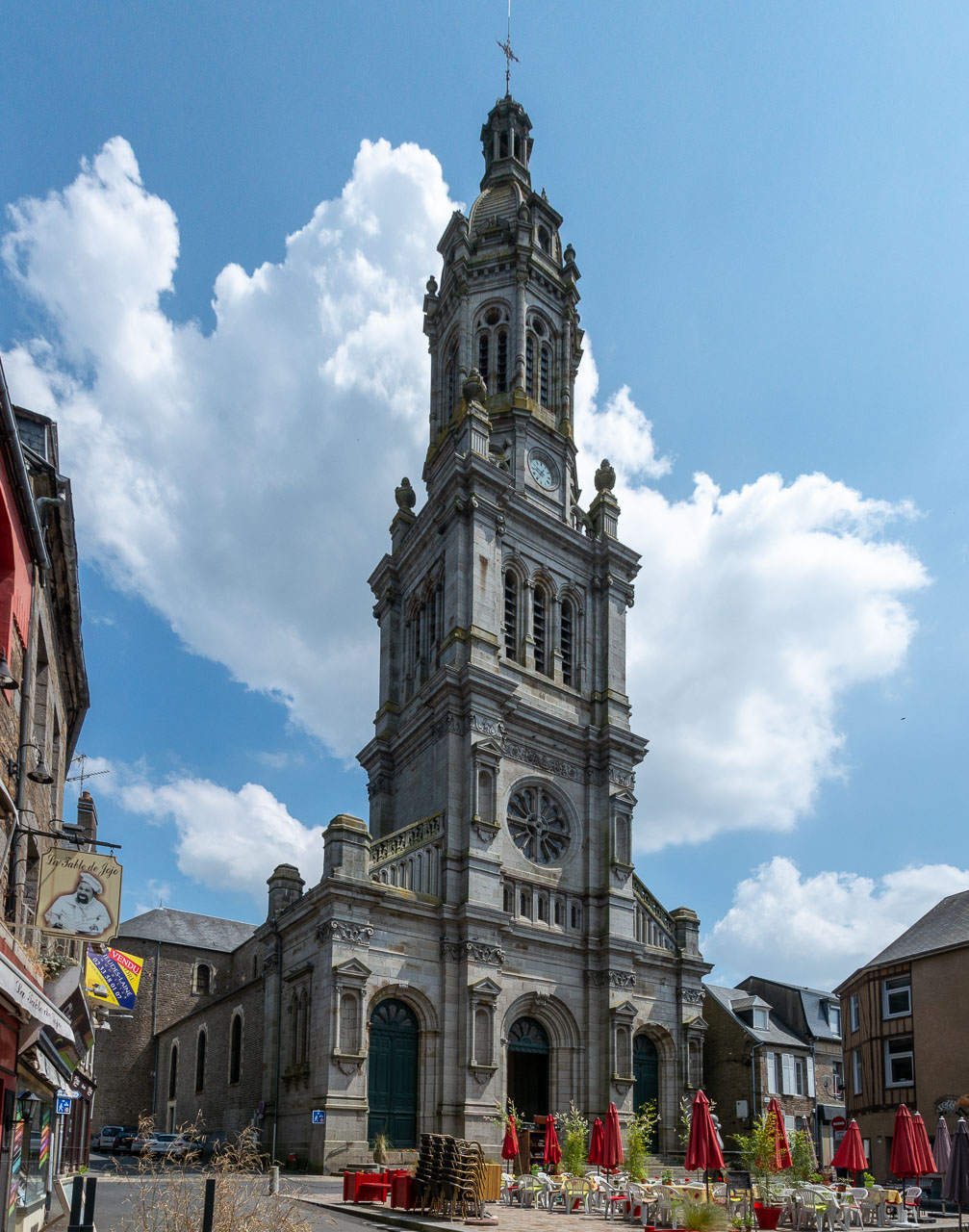
Having sampled the French EMS and the mind-numbing "hurry up and wait" routines of the hospital in Avranches, we decided on a late lunch and an exploration of this slightly larger town, population around 8,000. In 511 the town became the seat of a bishopric and later, the location of Saint Andrews, a major cathedral. In 933 the area was ceded to the Normans and became part of William the Conqueror's stomping ground.
Saint Sever Calvados
On the way back to base we decided to stop by this little burg that we had seen the previous day. Not a lot to see beyond a once grand abbey, it is yet another example of slowly atrophying French village with its declining population now less than 2,000. See Slideshow.
Saturday, August 18, 2018
Vire, Normandy, France
 |
| See Slideshow |
Vire suffered quite heavily during bombardments at the end of the Second World War, and much reconstruction and renovation took place in the following decade. The Church of Notre-Dame in Vire dates from the 13th - 16th centuries but includes elements from later periods and is predominantly in the Gothic style. See Slideshow.
Wednesday, August 15, 2018
Landelles et Coupigny, France
Back in the Spring we decided to re-visit Lower Normandy and Brittany in northwest France to fill in some gaps left following previous trips. We took a ship from Florida to Dover, England, disembarked a day early in Cherbourg, France, picked up an SUV and drove south to our first base, Landelles-et-Coupigny.
In 1789, the year of the French revolution, it is estimated that there were as many as 60,000 parish churches in France making them one of the most commonplace durable landmarks. The parishes were generally quite small even at that time but, following the extensive population migration to the cities in the 20th century and steadily declining church attendance, thousands of rural and small city churches are now unable to sustain themselves. There were at least three national legislative attempts in the 20th century to compel the merging of adjacent moribund communities but they were strongly resisted for obvious reasons.
The villages of Landelles and Coupigny, were ahead of their time in this regard and actually merged around the time of the revolution at which time each village had a population just more than 1,000. Over the ensuing 2 plus centuries the population of the merged villages increased to more than 3,000 in the 1960's but has since dwindled to less than 900. In recent decades, thousands of such small communes have been clumped into local communities of communes which essentially manage the provision of services such as water and trash pick-up. Inevitably however, with church attendance now at just 11% and urbanization nudging 80% the demise of tens of thousands small parish churches is only a matter of time. Visit them while you can! See slideshow.
 |
| See Slideshow |
 |
| See Slideshow |
Thursday, August 09, 2018
Domfront, France 2018
 |
| See Video |
 |
| See Video |
Another notable sight in town are the ruins of the medieval castle which was besieged by William the Conqueror, duke of Normandy in 1049. In 1092, the town's people revolted against the owner, Robert II de Bellême, and transferred their allegiance to the third son of William the Conqueror, Henri Beauclerc. Henri went on to become duke of Normandy and later, the King of England. Turbulent times continued for the next six centuries with ownership changing numerous times resulting from the location on the border of Normandy and Brittany.
In the adjacent community of Domfront-en-Poiraie is Notre-Dame-sur-l'Eau, the church of Lonlay Abbey priory. Built between the eleventh and twelfth centuries, it suffered many insults over the ensuing centuries but remains a key example of architecture in this region, although practically nothing of the original structure remains.
Lonlay Abbey itself is in the nearby village of Lonlay and its construction likely took place from the middle of the eleventh century until about 1100. Typically Benedictine in style, it is a good example of Norman Romanesque architecture. More pictures here.
.
Saturday, August 04, 2018
Horta, Azores 2018
 |
| Click for video |
Horta's economy is supported by agriculture, livestock farming, fishing, and tourism. Not a lot to see beyond an interesting glimpse into Portugal's colonial past but a welcome walkabout to break up an Atlantic crossing. The climate is very mild, being influenced by the Gulf Stream, with daytime temperatures normally falling in the range of 60F to 75F, although it is generally wet and cloudy. See some sights here.
Hamilton, Bermuda
 |
| Click for video |
Juan de Bermúdez, a Spanish sea Captain, was the first European believed to have recorded the islands, hence the name Bermuda. In 1684 the English Crown took over administration and in 1707 the islands became a British colony. Unlike the Caribbean islands to the south, Bermuda feels much more substantial and is certainly less gaudy although there is not much to be accomplished in a 9 hour visit except to gawk at a few buildings. A few of Hamilton's structures can be seen here.
Saturday, March 31, 2018
Liverpool Reprise, 2017
 We last visited Liverpool in 2011 and, at that time, had focused on cataloging some of the numerous city center pubs, visiting both cathedrals - Roman Catholic and Anglican, checking out China Town and marveling at the disappearance of 7-1/2 miles of dockland. In doing so, we completely overlooked the tawdry "birthplace of the Beatles" and the sorry little industry that has sprung up to exploit their fame. So, taking advantage of a brief stopover in this reinvented city, we decided to make amends. (Incidentally, if you ever find yourself in this interesting burg with a few hours to spare, a visit to each of the cathedrals is highly recommended to witness the dramatic differences in style.)
It is probably not possible to accurately separate fact from fantasy in the Mathew Street reconstruction that passes for the Beatles birthplace today. It is about sixty years since the group first appeared and, for a decade or two at that time, Liverpool had already been laboring under a painful transition from vibrant dockland to dereliction and latterly on to rebirth as a commercial center over the following decades.
Many years after hitting the music scene spotlight it was recognized that the Beatles were indeed an enduring phenomenon and that some kind of shrine marking their origin should be developed. In the interim however, buildings had changed hands, been re-purposed or even torn down and replaced, making the identification of many features impossible. In true huckster style and simply ignoring inconvenient facts, the entrepreneurs, intent on chasing their pots of gold, latched onto whatever property was available and developed a mishmash of make-believe and reality that continues to draw myriad tourists on a daily basis. Additional pictures here.
Friday, March 16, 2018
Rotterdam, Netherlands, 2017
 |
| Courtesy By Unknown Public Domain, https://commons.wikimedia.org/w/index.php?curid=196261 |
During WWII, the Germans seized the port after bombing it into submission in 1940. From this moment on, the city became an Allied target for the remainder of the hostilities. By the time the war ended in 1945 all but two historical buildings remained salvageable in the city center with the rest of the area being reduced to a wasteland.
Post-war reconstruction gave rise to much experimental architecture during the latter decades - the eighties and nineties - some of which was somewhat over the top. Nonetheless, the city is again a vibrant cultural and commercial success albeit with a few questionable oddities on display and very little in the way of historical sights. For more images, click here.
Wednesday, February 07, 2018
Bergen, Norway
 With it's current population approaching 300,000, Bergen is Norway's second largest city. It was, in fact, the largest city in Norway as recently as 1830 and actually served as the country's capital back in the 13th century. The current capital city, Oslo, is currently three to four times larger than Bergen. The city was founded in 1070 and, following steady growth, had become a bureau city of the Hanseatic League by the end of the 13th century ensuring great wealth for the many merchants in town.
The area around the original quays, now a World Heritage Site, came to be known as Bryggen and is presented to tourists as a series of retail stores. Sadly, there are few historical building examples in the city owing to numerous fires over the centuries which burnt razed large areas.
Bergen Port continues to be Norway's busiest, both in terms of freight and passengers with more than 300 cruise ship calls bringing nearly a half a million passengers to Bergen each year. More pictures here.
Sunday, February 04, 2018
Alesund, Norway
Alesund is located in More og Romsdal county at the top of Norway’s Western Fjord country. With the Sunnmøre Mountains as a backdrop, the town of almost 50,000 people straddles several islands stretching out into the Atlantic and all connected by bridges.
 A fire in 1904 destroyed much of the town which was subsequently rebuilt in stone using a dramatic Art Nouveau style. This style flourished between about 1890 and 1910 throughout Europe and the United States and is characterized by the use of long, sinuous lines.
Alesund is also home to one of Norway’s largest fishing harbors, is a base for cod and halibut fishing trawlers and is also
the headquarters of the Arctic sealing fleet. Slideshow here.
Thursday, January 18, 2018
Corner Brook, Newfoundland, Canada
 |
| A novel mode of transport into town |
 |
| What excitement! |
 |
| Most exciting sight was anchor maintenance on the big boat |
.
Sunday, January 07, 2018
Portree, Isle of Skye, Scotland

It is situated on the east side of the Isle of Skye and overlooks a sheltered bay boasting a pier designed by Thomas Telford, a notable Scottish Civil Engineer. Portee's population of about 2,500 souls, is largely supported by tourism. Click here for slideshow.
Friday, December 29, 2017
Orlando Christmas, 2017
 Christmas day turned up as a somewhat brisk, but sunny morning, just right for a troll around downtown to see what was happening. Beginning at Lake Eola Park, we spiraled outwards taking in the sights. as we went.
Lots of people were about, all with similar notions of enjoying the relaxed atmosphere on a bright and festive day. Thrilled to report that the exclusive greeting heard from numerous strangers was "Merry Christmas" with nary a single PC "Happy Holidays" to mar the mood. Thankfully, Joe Public, at least, seems to have their act together.
Overall, an Excellent Adventure! Click here for slideshow.
Saturday, December 16, 2017
Sydney, Nova Scotia, Canada
Cape Breton Island is on the Atlantic coast of Canada and part of the province of Nova Scotia. Although geographically separated from the Nova Scotia peninsula by the 1-1/2 mile wide Strait of Canso it is physically connected to it by the Canso Causeway.
 Sydney, founded by the British in 1785, was the island's capital until 1820 at which time Cape Breton was merged with Nova Scotia and the capital became Halifax. The town enjoyed rapid population growth after the turn of the 20th century when it became was home to the Dominion Steel and Coal Corporation and the town was incorporated as a city in 1904. Later, during both the First and Second World Wars, Sydney became a major staging area for England bound convoys and these activities also contributed to growth.
Following World War II, however, the steel mill and mining industries declined and the port activity decreased overall culminating in the loss of city status in 1995. Although the local and national governments nationalized the steel mill in the mid-sixties it continued it's decline and was finally closed in 2001.
Currently the economy is largely supported by a miscellany of customer support call centers and tourism. Also housed on the island are five reserves for the Eskasoni, Membertou, Wagmatcook, Waycobah, and Potlotek tribes of the Mi'kmaq Nation. See slideshow.
Wednesday, October 11, 2017
My First Electric Vehicle...
With all of the clamor regarding diminished global reserves of fossil fuel, the developing threat of bovine flatulence incinerating us all and the fact that I passionately dislike filling my car at the gas station, the time suddenly seemed right to explore an all electric vehicle.
 Now, unless you have a really, really long extension cord, it is necessary to install a battery to provide the motive power for any such form of transport. Two battery models were available, big, shown here and huge shown below.

 This is the base vehicle, a magnificent tricycle in Toy Town Red with a dashing front fender and big shiny handlebars.

Here it is again with the battery installed. Exciting Eh? I chose the HUGE battery because the nice man in the bike shop said "With that battery, you will be able to ride anywhere without fear or favor".
Certainly, from my excursions so far, he was absolutely right! Now, if I could just get it to stay on the road...


Friday, June 16, 2017
Forza d'Agro, Sicily - much AGRO for not much

Forza D'Agrò remained loyal to the Spanish during the anti-Spanish revolution of 1674 and was later occupied by British forces in the early 19th century for defense against Napoleonic attacks. In the early 20th century, many of the inhabitants emigrated to America.
Fortunately, the area was fairly unscathed by the 20th century world wars and today, much of the town interior consists of traditional 14th century buildings and cobbled alleys largely unsuitable for vehicular traffic. This has led to the village being favored as a backdrop for several movies, including naturally, The Godfather trilogy. Following are a few pictures of the highlights of this forgotten burg.
Savoca, Sicily - another Hollywood has-been
 Savoca is a small Sicilian village of 1,600 people or so, built 1,000 feet up on a rugged mountainside that looks out over the Mediterranean at the southern tip of the "toe" of Italy. One of hundreds of similar crumbling and near forgotten communes throughout Sicily, Savoca was used and abused by the Hollywood machine and, 44 years later, remains conflicted about its identity as a result of that visitation.
For good or bad, it was selected as a location for some scenes of the Godfather movie series and was invaded in 1972 by Francis Ford Coppola and his gang of users. Since the first movie's release, daily coach loads of tourists make the tiresome trek to the village and jump through the hoops set out by the tour companies and the natives. The inhabitants are split into two groups - the haves, including church managers charging admission, the Post Office, the coffee and souvenir shop, the enterprising owner of the three-wheeled taxi who offers rides to the church and, of course, the proprietor of Bar Vitelli that appeared in one or more of the movies. Remaining are the have-nots - residents, retirees and holiday-homers seeking the earlier tranquility and solitude, now hesitant to venture out between the hours of 10 am and 4 pm to compete with the visiting hordes straining the meager local services to breaking point.
We were dropped off at the Convento dei Cappuccini to gaze at a bunch of dead bodies in the catacombs as you can see here...
Subscribe to:
Posts (Atom)
